
Why Supporting a Girl to Study Hospitality at Tewa Matters.

In Kilifi, hospitality is more than a career. It is an opportunity to build a different future.

Kilifi is a county of remarkable beauty and enormous potential. Its 200-kilometre coastline, beaches, marine life, cultural heritage and growing tourism industry attract visitors from Kenya and around the world. Yet behind this thriving tourism potential is a community where many young people, particularly girls, continue to face significant barriers to education, employment and economic independence.
For a girl in Kilifi, access to quality hospitality training can mean far more than earning a certificate. It can mean gaining the skills, confidence and income to make choices about her own future.

Kilifi remains one of Kenya's economically disadvantaged counties. According to the Kilifi County Integrated Development Plan, 46.1% of the county's population lives in monetary poverty, compared with a national rate of 35.7%. Approximately 670,448 people were estimated to be living in monetary poverty. The situation is even more concerning for young people: 61.8% of youth in Kilifi were identified as multidimensionally poor.
For families living with limited resources, continuing education after secondary school can be difficult. A girl may have the ability and ambition to study, but the cost of tuition, accommodation, transport, meals and learning materials can place further education beyond her family's reach.
And when education ends, economic choices become narrower.
When a girl cannot continue her education, the risks grow.
Early pregnancy and marriage remain important challenges for girls in Kilifi.
The 2022 Kenya Demographic and Health Survey (KDHS) found that 13% of girls aged 15–19 in Kilifi had ever been pregnant.
The county has made progress. Kilifi's own development reporting indicates that teenage pregnancies fell from 26% to 14% between 2019 and 2021, alongside an increase in primary-to-secondary school transition from 26% to 90%. More recently, county health officials reported that teenage pregnancy rates in Kilifi and Chonyi had declined from about 21% to 15% following a three-year adolescent health intervention.

But these numbers represent girls whose lives can be permanently changed by whether they remain in school and gain pathways to meaningful livelihoods.
The connection between education and opportunity matters. Nationally, the 2022 KDHS found that fertility decreases as women's education increases: women with no education had an average of 5.3 children, compared with 2.8 among women with more than secondary education.
Education does not simply prepare a girl for a job. It expands her choices.
Why hospitality makes sense for a girl in Kilifi
There is a unique opportunity in Kilifi because the county's greatest economic assets are right on its doorstep.
Tourism and hospitality are identified by the County Government as priority sectors for economic development. Kilifi's own tourism strategy specifically calls for skills development and training for workers in the hospitality sector, as well as greater local participation so that communities can share in the benefits generated by tourism.
And the opportunity extends beyond Kilifi.
Kenya's tourism sector generated approximately KSh 352 billion in inbound tourism earnings in 2023 and contributed about 1.1 million direct jobs, with tourism accounting for around 10–11% of national GDP.
This is the industry that Tewa Training Centre prepares young women to enter.
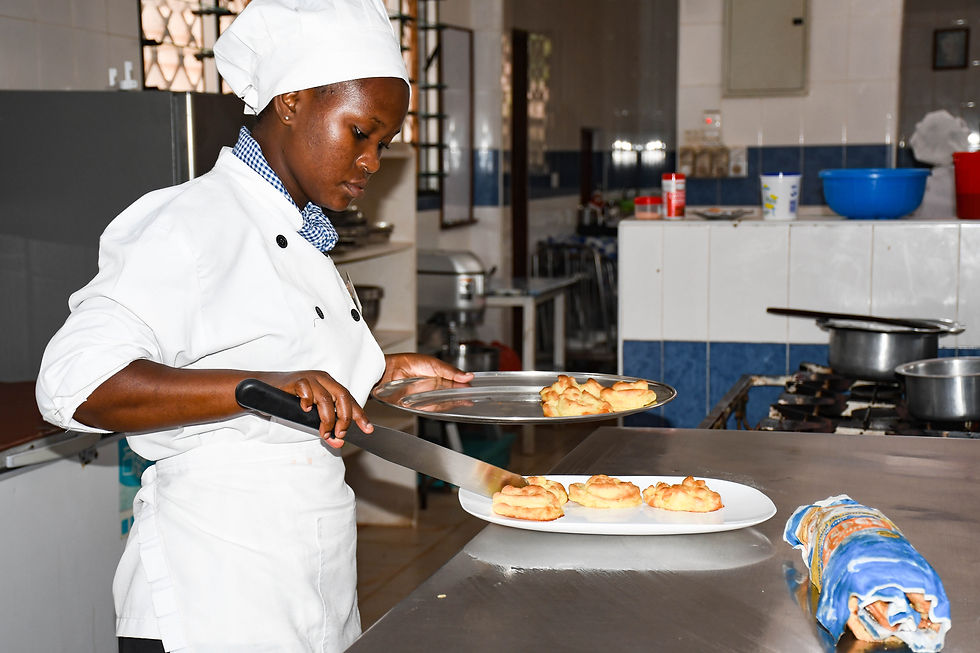
A girl who studies hospitality at Tewa can develop practical skills in areas such as food production, food and beverage service, housekeeping, customer service and other areas of the hospitality industry. More importantly, she gains exposure to professional standards and an industry that exists within her own county and across Kenya.
From the classroom to a livelihood
At Tewa, we believe vocational education should be connected to the real world.
Our goal is not simply to graduate girls with certificates. It is to prepare them to work, earn and build independent lives.
Hospitality is a skills-based industry. A trained young woman can pursue employment in hotels, restaurants, lodges, resorts, catering companies and other tourism-related businesses. With experience, she can also create her own enterprise.

This matters enormously in a county where poverty and unemployment limit the choices available to young people.
The Kilifi County Government itself has recognised the importance of strengthening TVET and vocational training, increasing access to technical skills and creating opportunities for youth employment and entrepreneurship.
Supporting one girl can change the trajectory of a family.
When you support a girl to study at Tewa, you are not simply paying for her education. You are investing in a young woman who can enter the workforce with a marketable skill.
You are helping her replace uncertainty with opportunity. You are giving her the confidence to imagine a future beyond early marriage or dependence.
And when she begins earning, the impact can extend beyond her. Her income can contribute to her family's wellbeing, support siblings' education and help create greater economic stability in her community.
This is why investing in girls matters. A girl with education has choices. A girl with skills has opportunities. A girl with an income has greater power over the direction of her life.
Let Kilifi's tourism industry work for its girls.
Kilifi should not only be a destination where tourists come to spend money. It should be a place where local young people can build meaningful careers from the opportunities created by tourism.
The county has the coastline. It has the culture. It has the tourism potential.
Now, it needs skilled young people who can participate in and benefit from that economy.
At Tewa Training Centre, we believe Kilifi's girls should be among them.
Supporting a girl through hospitality training is therefore an investment in more than one student. It is an investment in a skilled workforce, stronger families, greater economic participation and a future where a girl's circumstances at birth do not determine the possibilities available to her.
Give a girl skills. Give her opportunity. Give her a reason to believe that her future can be bigger than her circumstances.
Sources
Statistics in this article are drawn from the Kenya National Bureau of Statistics 2022 Kenya Demographic and Health Survey, the Kilifi County Integrated Development Plan 2023–2027, and Kenya's Ministry of Tourism.


Comments